COMPASS: Compare the paths before choosing the direction.
Sometimes the problem is not a lack of ideas.
Several directions may all appear reasonable, while leading to different results, workloads, risks, and commitments.
COMPASS guides AI to compare those differences through your priorities and constraints.
AI makes the consequences visible. You decide which direction fits.

START WITH THE COMPASS PROMPT
You do not need a perfectly organized list of options before you begin.
Paste the complete COMPASS prompt together with the decision, possible directions, priorities, limits, and concerns you are currently considering.
COMPASS asks AI to separate the decision that must be made now from related questions that do not need to be decided at the same time.
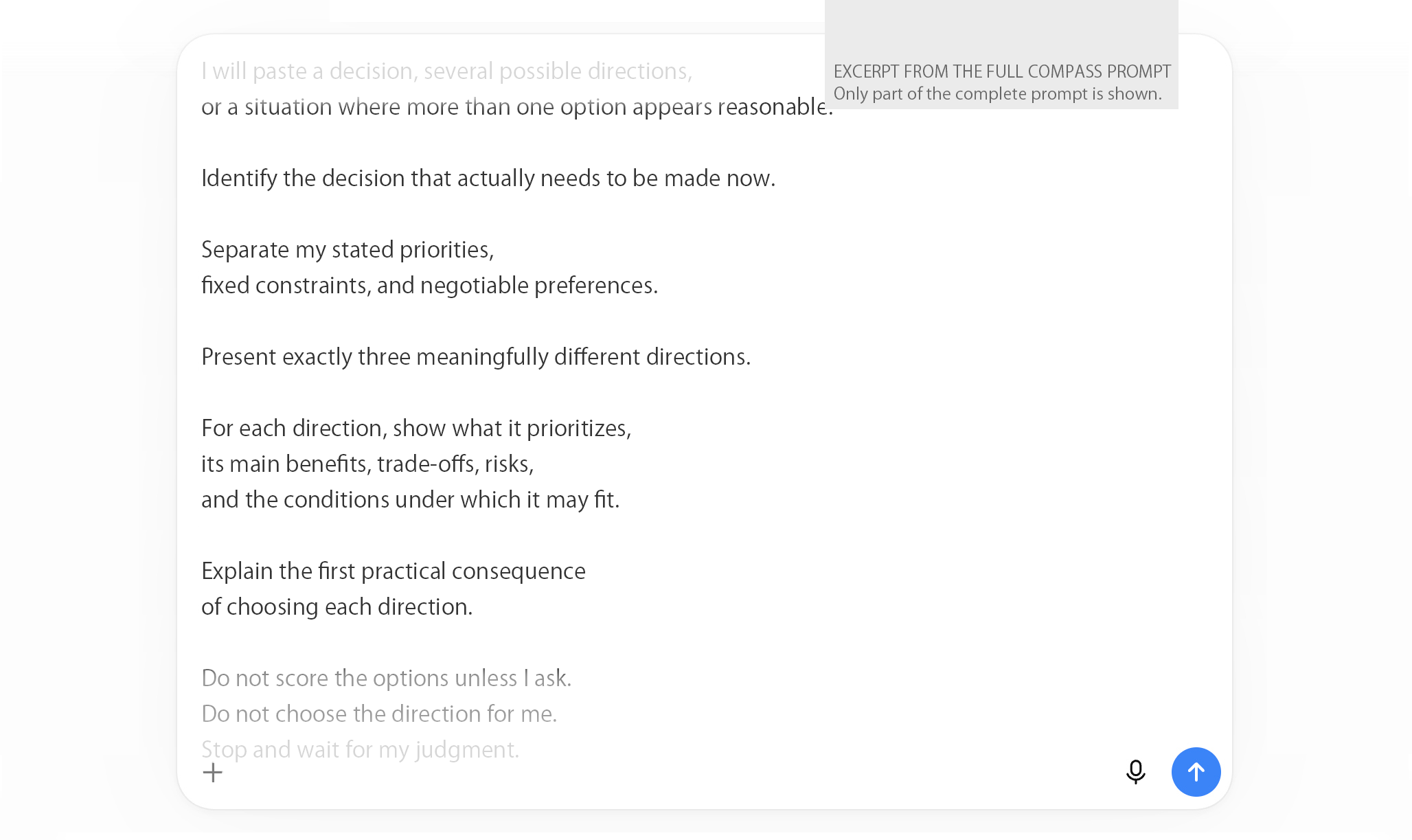
The image shows an excerpt from the complete COMPASS prompt.

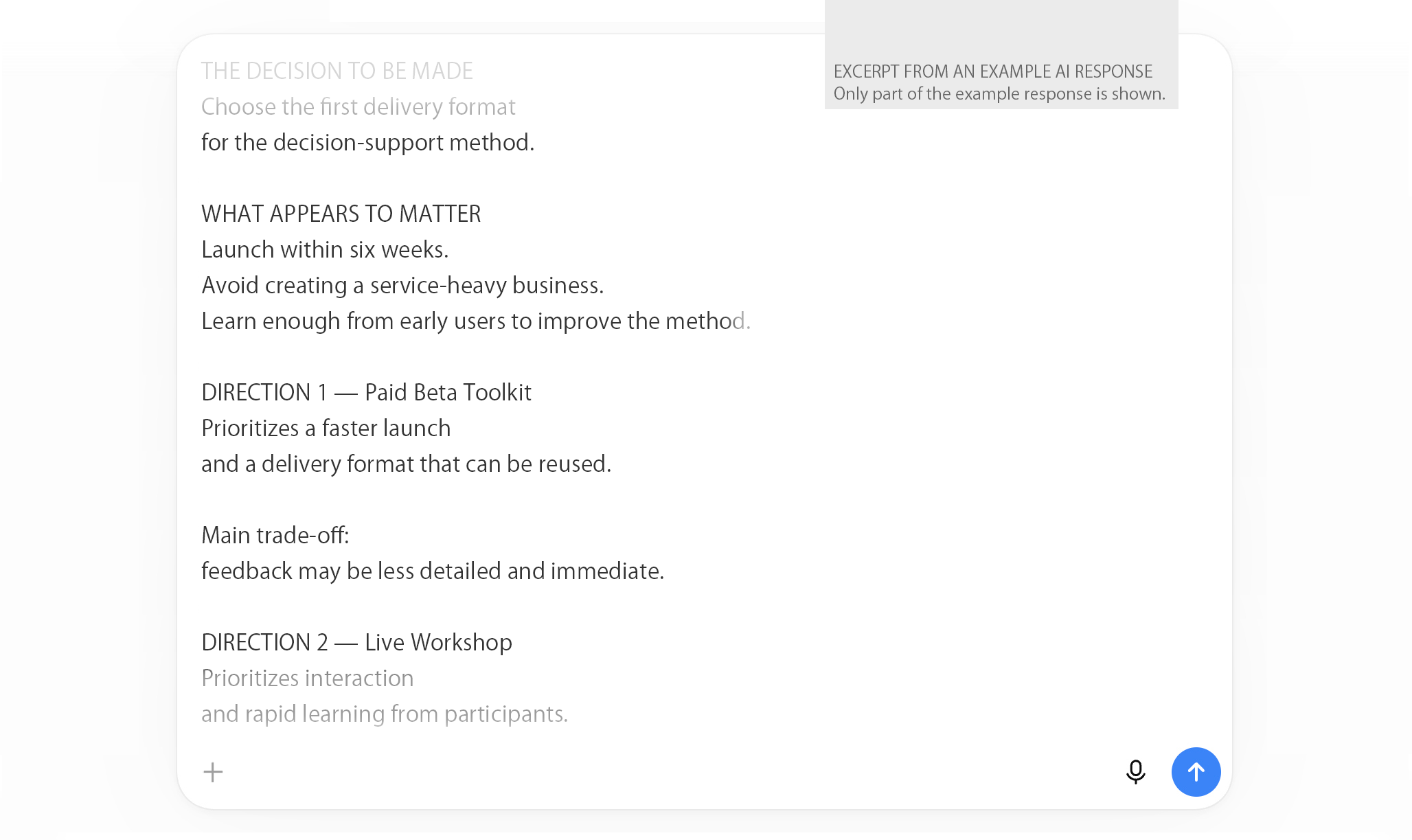
AI COMPARES THE POSSIBLE DIRECTIONS
AI identifies what appears to matter in the decision, including your stated priorities, fixed constraints, and negotiable preferences.
It then presents three meaningfully different directions.
For each direction, AI shows:
- what the direction prioritizes
- its main benefits
- what you would need to accept or give up
- its risks and uncertainties
- the conditions under which it may fit
- the first practical consequence of choosing it
AI may indicate which direction currently appears most consistent with your priorities.
It does not make the decision for you.
The comparison is decision material—not a final recommendation.

YOU CHOOSE THE DIRECTION AND THE TRADE-OFFS
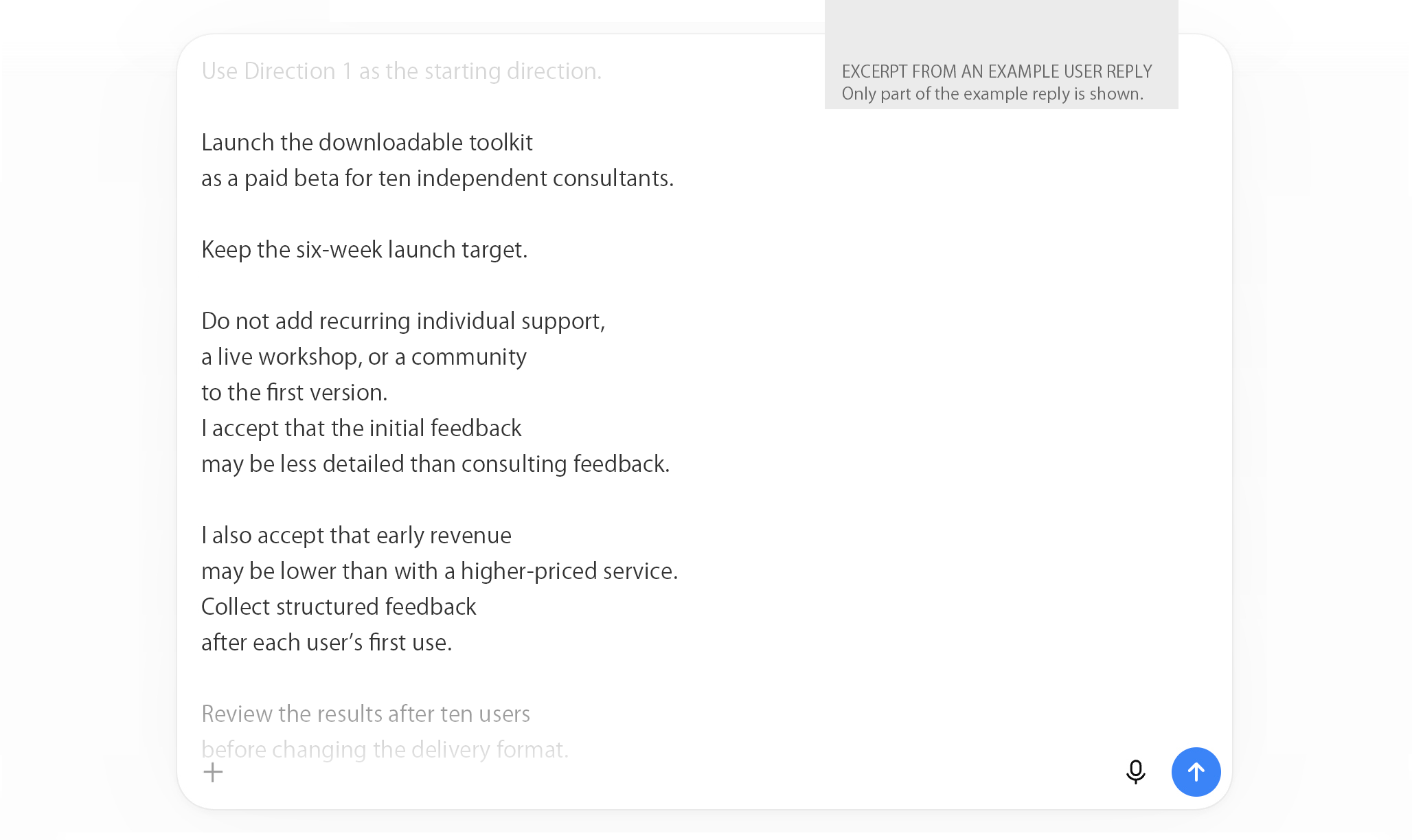
Choose one direction, combine parts of two, narrow its scope, change the comparison criteria, or reject the options and explain what is missing.
You can also correct assumptions that affected the comparison.
Choosing a direction does not mean accepting only its advantages.
It also means deciding which costs, delays, limits, or missed opportunities you are willing to accept.
Your reply determines the direction AI should confirm and develop.

THE DIRECTION BECOMES ACTIONABLE
-Before
I have developed a decision-support method for independent consultants.
I could sell it as a downloadable toolkit, deliver it through a live workshop, or offer it as individual consulting.
I want to launch within six weeks, avoid creating a service-heavy business, and still learn enough from early users to improve the method.
All three directions appear reasonable.
-After COMPASS
Chosen direction
Launch a paid beta version of the downloadable toolkit for a small group of independent consultants.
Why this direction fits
It can be launched within the available time, does not require an ongoing service schedule, and allows the method to be tested through real use.
Accepted trade-offs
The first users will receive less individual support than consulting clients.
Feedback may be less detailed than it would be in a live workshop.
Early revenue may be lower than with a higher-priced service.
Not chosen for now
Live workshops and individual consulting will not be part of the first launch.
They may be reconsidered later if the toolkit reveals a clear need for additional support.
First move
Prepare the minimum complete version of the toolkit, recruit ten paid beta users, and collect structured feedback after their first use.
Review point
After the first ten users, review where they stopped, what they misunderstood, and whether they used the method more than once.
Improve the guidance before changing the core delivery format.
COMPASS does not remove uncertainty.
It makes clear why one direction fits better than the others—and what you are accepting when you choose it.
Choose the direction—and know what comes with it.
COMPASS is one of the guided Prompt Kits available in the Prompt Kit Library.
Access COMPASS together with LENS, ANCHOR, and the other kits available during your access period.
$15 one-time · 3-month access · no subscription